
By Thomas Martin, retired master electrician
I
July 4, 1976
I was in the midst of a stint within the fence line and walls of an institution formerly known as “Matteawan State Hospital,” in Beacon, NY. Not as an inmate, but as an electrician—aka “Sparky”—working for one of the many contractors regarding its remodel.
Two interests came up from the Big Apple to this area of the Hudson River Valley. One had a fair amount of boat replicas from 1776 onward, including one tall ship, as seen from the tiller of my small sailboat, when not tied at Parrott Docks, in Newburgh, NY. The other was an Italian mason who had gone through two other Sparkies, both quitting, resulting in an edict from my foreman to me.
“When returning from the Fourth, you’ll be working shoulder to shoulder with this guy on scaffolding in all outside areas. He’ll be working with ten inch-web style-block with a brick finish. You’ll be weaving your conduits within his blocks. Orchestration is paramount!”
As his rhetoric rambled, my mind quietly unreeled the past ten months of my tenure, where I experienced a number of eerie episodes that were interrupted when his spiel turned to repetition.
Consequently, I cut him off. “Stop! I understood you to say that I’d be out of the population. No need to say another word.”
Curtly he replied. “I don’t care that this guy is old, gruff, and sounds like he stepped off the boat yesterday. Just make it happen, no matter what, and don’t let me down!”
I had just made journeymen and was like a horse at the racetrack, bubbling with exuberant energy, eagerly awaiting the gate opening. I responded with a hometown boy does good desire. “You can count on me; I’ll do my very best for you!”
Day one: Onset of bandy-words between the Sparky and the old-timer mason.
“Morning, my name is Tom, I’m your new Sparky. “Your name, please?”
“Humph,” the old-timer mason said.
“My pipes are stubbed to where your block work is to begin.”
“Humph.”
“Let’s make a start.”
“Pipes slow me down, I do work, no pipes, when youus a gleam in youus Papa’s eyes.”
“Like it or not, we’ve got to work together.”
“Humph.”
“Old-timer, I got bills to pay, construction is slow, and I can’t go back inside. I’m having nightmares, where I can’t get out.”
“Humph.”
Somehow, we make it to the start of floor two without any trouble.
“Old-timer, I’m going down to get parts, don’t bury my pipes.”
Back on top of the scaffolding, I pull the rope that’s tied to the bucket, holding my supplies.
He pointed to himself. “Kid—Rope—Bucket—Mine—No use!”
“It won’t happen again, old-timer, let me get my pipes set, so you can continue working, then I’ll hunt down my own rope and bucket.”
Upon my return, my pipes are inaccessible, so I took apart some of his blockwork.
“Old-timer, you’re getting on my bad side, but you’ll have to throw me off this scaffolding. I’m not leaving!”
Shaking his head no! He looked at his feet. When his head lifted, he gave me an antagonistic look, reminding me of when I knocked over the beehive nest as a youngster.
When reaching the third floor, between the pipes, blocks, and brick, things turned bad.
“Tommy, give Biagio a hand, lift blocks over pipes, too awkward. Why you stop work, hands in pockets, smile on face?”
“Well. Pleasure to meet you, Biagio. You asked for help, but contractor regs say no! I’ll tell you what, though, I can set my watch when my foreman comes by, which is soon. When he passes, we’ll lift those blocks together.”
After a fortnight, he asked, “What’s-matter-you, no smile, no whistle, no wise-man!”
“I’ve been married for a year, and my wife and I are talking about children. I’m thinking we should wait, she’s saying, “wait for what?”
Smiling, he said, “La Familia E Tutto,” then with his best English, Family-Everything. Give Biagio phone number. I call. Talk to wife. Help you out.”
Now my head was shaking, no! “I’m troubled by the glow in your eyes, the smile on your face, and your suave gesture of kissing the wife’s hand. I was born at night, but not last night. Hey, is it wise-man or wise guy?”
Together we broke out in laughter and then laughed some more.
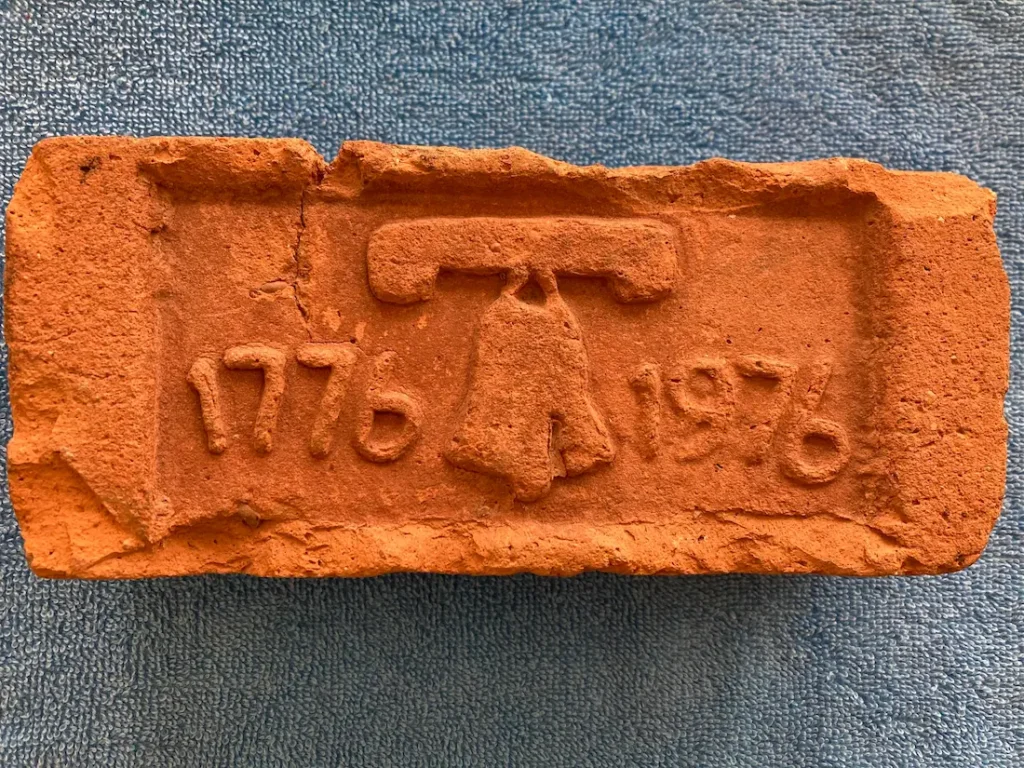
“The grapevine says that sometimes in a pallet of brick, there is one brick that’s stamped with 1776 Liberty Bell 1976. How do I get one?”
He gave me that same hostile look as before, creating a chill feeling in the air. He sighed and said, “Just another brick in wall.”
I went mute and plied my trade. Eventually, he stopped working, smiled, and said, “See Frankie-my-bossman, my brick home on mantel. Who’s wise-man now?”
Our newfound laughter would stay with us to projects end.
Over lunch one day, while we sat on overturned buckets, he asked, “Tom, what like inside wall?”
II
Fortunately, I had an assigned Correctional Officer (CO), named Bill, who said, “I got your back Tom!”
My angst started every morning, when we contractors made our way in, like being packed into a subway car. Followed by closing gates, that made echoing sounds, like a blacksmith with a blow of his hammer upon the anvil.
Some days were in population, others were in locked isolation, like the basement, where you had to ring a doorbell and wait to get out.
Daily, I would solo walk the long women’s corridor, with my best smile, offering a “Good morning or good afternoon, ladies.”
Once, I was held in a cafeteria lockdown until the one missing fork was accounted for. Another time, an inmate grabbed my hacksaw while working within an occupied ward. Then, there was the unoccupied bullpen area. As I stood atop a ladder, with slack rope on the floor for a wire pull, when suddenly, the place filled with inmates, one of whom picked up the rope’s end. Bill saw my expressed fear. And with his steadfast, calm voice addressed the situation.
“Joe, right? Please don’t handle the rope, Joe.” He then said to me, “There’s a bit of bad in the best of us and a bit of good in the worst of us. I always promote the good.”
Lastly, I was in ward two at the hospital, which was as quiet as a library. That changed quickly – like a lit firecracker, when a trusted inmate took a nurse to the terrazzo floor. His actions were humanely countered by COs and nurses, rallying together, subduing the attacker, as Bella, the nurse, lay on the floor, then sat upright, rolling to her knees, saying, “Another day in the salt-mine. I’m ok, give me a hand up please.”
“I think the nurses and COs need to be on the unsung hero list and should be recognized.”
Lifting his coffee, he said, “Hear! Hear!”
III
Our work was finishing up. We were at the fifty-foot level, with a view of the Hudson reminding me of sailing. Then. Like a lightning flash, my mind went into muse mode; “but for the grace of God there go I,” in that I needed to walk in another man’s shoes to understand their story, that I’ve been on a special journey, that awakened a self-imposed goal for me to seek humility.
I shared a postage-stamp-sized workplace, high from safety, working alongside a man who was aged and arthritic, and occasionally danced with his wife in make-believe style when he had the scaffold to himself. A man with heavily calloused, swollen hands the size of baseball mitts, that trembled, then went to the finesse of a violinist as he put the touches to his ornate placement of the blood red brick.”
Suddenly, I realized that his hands were violently shaking as he reached into his pants pocket, fishing out a flattened paper coffee cup, shaping it back to its original size, then dipped it into the bucket that kept his trowels wet, and was about to take a drink.
“Biagio! Wait, I’ll get you water.”Down the fifty feet I went. Rummaging, I found a Coke bottle and brought it to the laborer, who had access to house water.
When I was halfway up the scaffolding, my foreman yelled, “If he buried your pipes, I’ll fire you!”
Ignoring him, I made it to the top and handed Biagio the water.
He said, “Tommy youus gentleman-s.”
IV
My brick sits by our wood stove in our two-story home, which my wife, I, and our four sons constructed. In part, we built two eight-inch parallel chimneys, each thirty-five feet tall. Biagio was with me in spirit, for every block laid.
My life is fading like a sunset; sometimes I think about the work, but it’s his motto, “La Familia E Tutto,” that stays with me.
Happy Two Hundred and Fiftieth America!
THE END
Editor’s note
In celebration of the 250th anniversary of the Declaration of Independence, this story is an exception to the Beacon Love Bites 150-word limit.
And in the words of the story’s author, Thomas Martin: “This essay is for those that do most of the working, living, and dying in town, in spirit only from Frank Capra’s It’s A Wonderful Life.”