
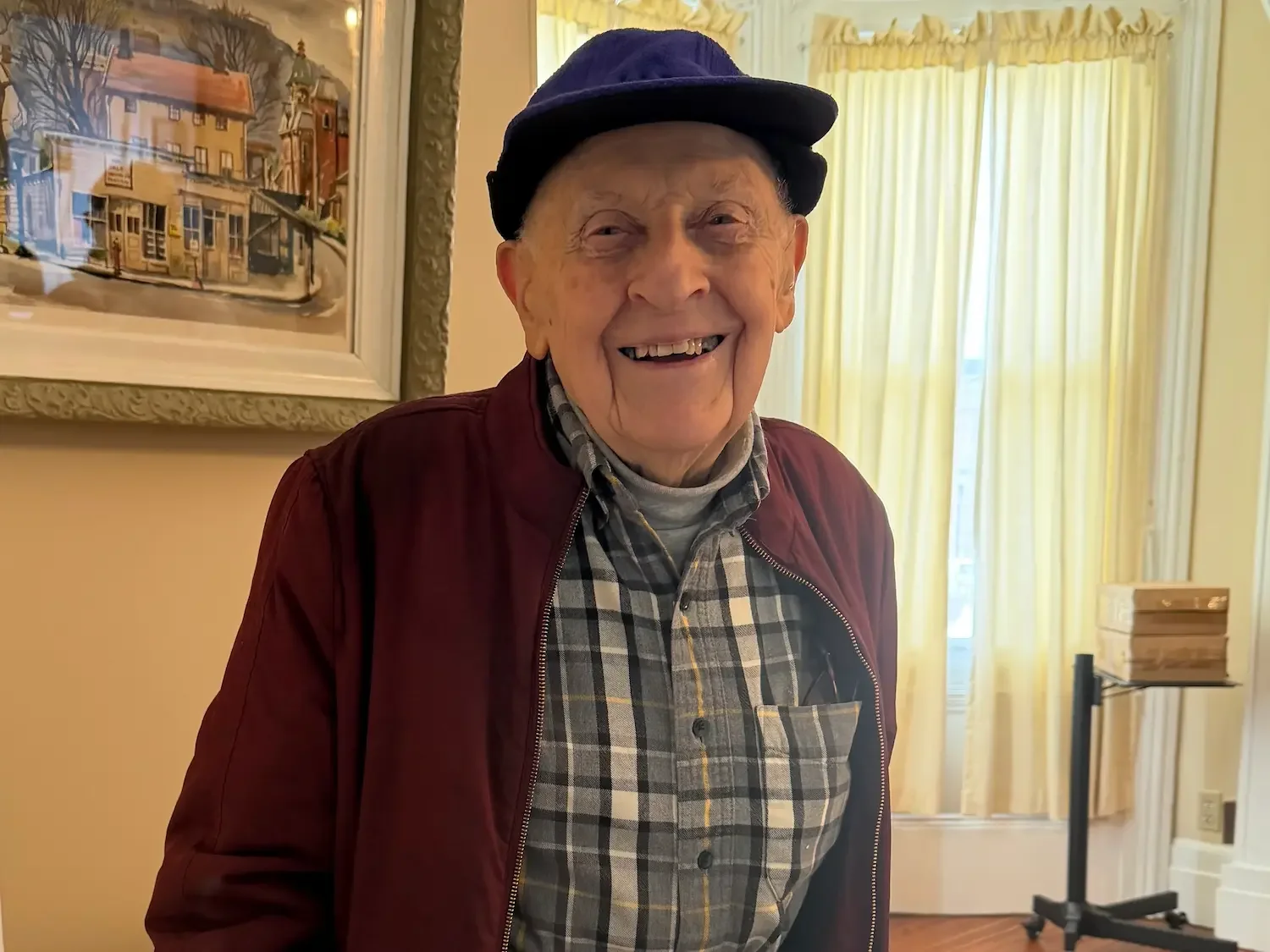
Meet George Atkinson, a lifelong Beacon local who’s seen it all
Beacon’s story is the stuff of legend: a booming industrial town, a long decline, a boarded-up Main Street, and a hard-won revival that began in the early 2000s, fueled by a community that refused to give up on it.
I recently had the opportunity to meet an actual Beacon legend who lived that entire history firsthand. He’s someone who remembers the Great Depression and World War II, who heard Franklin D. Roosevelt’s stump speech in Bank Square in 1944, and who even met Harpo Marx. He’s a man who’s watched Beacon rise, fall, and rise again.
How many of us can say we were there?
Meeting George
When I met George Atkinson—a long-time volunteer at the Beacon Historical Society (BHS)—the BHS team had arranged for us to chat in one of the libraries on the third floor of their headquarters at 61 Leonard Street.
George marched ahead of me, skipping up the stairs without missing a beat. This would mean nothing if it weren’t for the fact that George happens to be a diminutive, 99-year-old with an encyclopedic memory and a disarming smile that lights up a room. Hearing his stories makes me feel as if I had been there myself. This is not lost on someone who loves this city every bit as much as a Beacon old-timer does.
George’s Story
George has lived in Beacon his entire life. In fact, he was born in the house he still lives in today at the east end of Main Street. Every week, he and multiple generations of his family head to the Yankee Clipper Diner (397 Main Street) for a bacon and eggs breakfast and a catch up.

Early Memories
Born in 1927, George was the youngest of nine children whose father’s family came from Selby in Yorkshire, England. His first memory as a four-year-old is a somber one—watching his dad take photographs of his recently deceased uncle in his coffin in the living room.
He also remembers wearing dresses as a four or five-year-old because, although his mother was a seamstress, it was easier for her to make a dress than pants for a rapidly growing child. A busy mom needs to make pragmatic decisions, especially one with a bustling houseful of children.
He went to kindergarten at Spring Street school and eventually attended the high school in 1939 at 211 Fishkill Avenue—now the KuBe Art Center—just as a new wing with machine and woodworking shops as well as a molding bench for sculpture had been added. George still has a bust of Abraham Lincoln he made there.
The Great Depression
There are countless stories of how The Great Depression devastated cities and communities, but some were more fortunate than others.
“We were the lucky ones,” George explains in his characteristically sunny way. “My father had a steady job. He didn’t make a lot of money, but it paid the bills and kept a roof over our heads.” It helped that his oldest brother—who was 23 when George was born—worked on the New York Central Railroad and contributed to the pot before he got married. “We didn’t have it too bad,” he says. “But we lived week to week, for sure. In places like Beacon, there was always work to find, even if it was just chopping wood.”
Later, after the 1941 bombing of Pearl Harbor forced the U.S. into World War II, Beacon High School introduced a wartime training program to train women and high schoolers how to make machinery that would be used in the war effort.
Working Life In Beacon
After leaving school at 16, George went to work for the Dutchess Tool Company (long since gone), on South Avenue. There he trained to make telemotors for the iconic Liberty ships that played a significant role in helping the Allies win the war. And because most of the young men were away at war, George was a 16-year-old working alongside women and “old-timers” who would endlessly tease him. Some things never change.
Fortunately for George, because of his age, he wasn’t drafted into the army until April of 1946. He was one of the lucky ones who never experienced the horrors of the frontline. Serving in the army medical corps, he met fellow recruits from across the country, and he delights in sharing that he once met curly-wigged comic genius, Harpo Marx of the Marx Brothers, who came to entertain the troops one evening.
When The Jobs Disappeared
George moved through a string of manual jobs after leaving the army before eventually finding steadier footing—first with the USPS, then at the Marathon Battery plant in Cold Spring where he spent 17 years until the company relocated overseas. George’s path mirrors a broader shift unfolding across Beacon, the Hudson Valley, and much of the country in the 1960s and 1970s; domestic manufacturers shuttering U.S. operations in pursuit of cheaper labor and wider profit margins abroad.
A Volunteer For BHS
George has been a volunteer with the BHS for more than 10 years—his uncanny memory and keen interest in the world making him the perfect candidate to support the organization.
He fondly reminisces about visiting the Howland Library—now home to the Howland Cultural Center (477 Main Street)—where there were plenty of books for young boys on how to make just about anything that might capture a youngster’s imagination.
A member of the First Presbyterian Church (50 Liberty Street) since childhood, George served for many years as a church elder before recently retiring. He vividly recalls when the original structure—which was designed by the iconic Gilded Age architect Richard Morris Hunt who also designed the Howland Cultural Center, the music room at the former Tioronda Estate (soon to be Mirbeau Inn & Spa), the Biltmore Estate, and the pedestal of the Statue of Liberty—was destroyed by a fire in 1943. With the country in the throes of a world war, there was no chance it would ever be restored to its former glory. A simple but elegant replacement was eventually built.
A Letter From FDR
One of George’s treasures is a letter from FDR while the future president was still New York State’s governor. The letter was written in 1932 to George’s uncle who was a carpenter and treasurer of the local union. Roosevelt—who visited Beacon each election cycle—would give his stump speech in Bank Square at the west end of Main Street, near where Bank Square Coffeehouse (129 Main Street) stands today.
George remembers he and his friends being released from school at noon to hear FDR speak. Years later, in 1944, as an employee at the Dutchess Tool Company, George returned to hear FDR’s final presidential campaign speech in Beacon before the president died in April 1945, just weeks before the Allies formally declared victory in Europe.
FDR was not the only Roosevelt to spend time in Beacon. In the early 1940s, when George was a teen, Mrs. Eleanor Roosevelt would also occasionally visit the city to see Mrs. Jane Mcllwraith, a descendent of Madam Brett and a DAR (Daughters Of The American Revolution member). George recalls watching a huge black limousine mistakenly pulling onto Churchill Street and having to make a turn to course correct. He saw the passenger lean forward and recognized her as Mrs. Roosevelt. What struck him is that the first lady’s only security detail was a lone MP (military policeman) even though the war was still raging.
Memories of Main Street: The Butcher, The Baker, The Candlestick Maker

George’s reminisces about the east end of Main Street conjure a picture of the city as a literal beacon for the immigrant dream. He speaks of Polish butcher, Walter Petrosky, for whom he delivered orders after school. Next door to the butcher was John Hannan, the Irish grocer. Then there was an Italian shoemaker named John Petro Gallo, and Harry Luca who owned a Chinese Laundry. George proudly says Beacon was like a mirror of the United Nations.
No Kissing Girls
Weekends as a child often involved catching Roy Rogers movies at the long-gone Paragon Theater next to what is now the Yankee Clipper Diner (397 Main Street). It was all about the action for young George. “If a cowboy kissed his horse, I was okay about that. But if he kissed a girl, then that would ruin the movie for me!”
Hot Dog!
A post-movie ritual involved George and his older brother stopping at Joe’s Texas Lunch—now a part of Wonderbar and the Beacon Movie Theater (445 Main Street)—for the best hot dog in the city. “Nobody could match Joe’s chili hot dog—the chili, the sauce, the recipe!” These hot dogs were so legendary that the story on the street was Beacon’s soldiers returning from Vietnam would make Joe’s Texas Lunch one of their first stops.
Swimming In The Fishkill Creek
If you ask George his favorite season in Beacon, he’ll tell you summer. Remembering back to his childhood, he shares, “We had a swimming hole right over here in the Fishkill Creek.”
Unfortunately for Beacon’s kids back then, the factories started releasing their chemicals and dyes into the water and the swimming had to stop. Undeterred, George and his buddies would jump on their bikes and ride several miles to Glenham to swim there instead. Summer consisted of swimming and baseball, followed by football in the fall. “There was no organized sport for kids in my day. We just came together and played,” he said.
A Man Of Many Interests

So, what does a man of 99 do with his spare time? With a lust for life, a positive outlook, and a keen interest in everyone, George has little intention of slowing down. “I’m pretty busy,” he proudly declares.
In 2025, George took the stage at The Roundhouse Waterfall Room (2 East Main Street) where he was honored at the BHS’s annual gala for his dedication to the preservation of the city’s history and his volunteer service. He’s helping the organization celebrate its 50th anniversary this year.
Aside from his volunteer work at BHS and the church, George is a member of the Brits Of The Hudson sports car club. 90 or so members of the club get together once a month to swap notes and admire their MGs, Triumphs, and even a Rolls Royce, as well as to enjoy an annual summer picnic together.
What’s more, he’s also a member of an international club called the Experimental Aircraft Association who are working on a 10-year project to build an airplane in Kingston, NY.
When I asked George what advice he has for the generations behind him, he said without hesitation, “Eat well, look after yourself, and keep busy!” Wise words, indeed.
50 Years Of The Beacon Historical Society
And in the words of yet another Roosevelt—Theodore Roosevelt— “The more you know about the past, the better prepared you are for the future.” This certainly resonates in a place like Beacon. Whether you’ve been here a year or 100 years, the case for preserving and sharing the city’s history isn’t just sentimental—it’s a must for us and for those who come next.
This year, the Beacon Historical Society celebrates its 50th anniversary. Become an annual member or even a volunteer to support the tireless work of this entirely volunteer-run organization. Find out more here.
Sign up to our free weekly newsletter to discover all good things in Beacon, NY. And if you enjoyed this feature, why not share it with a friend?
Until next time…
The Beacon Beacon🧡